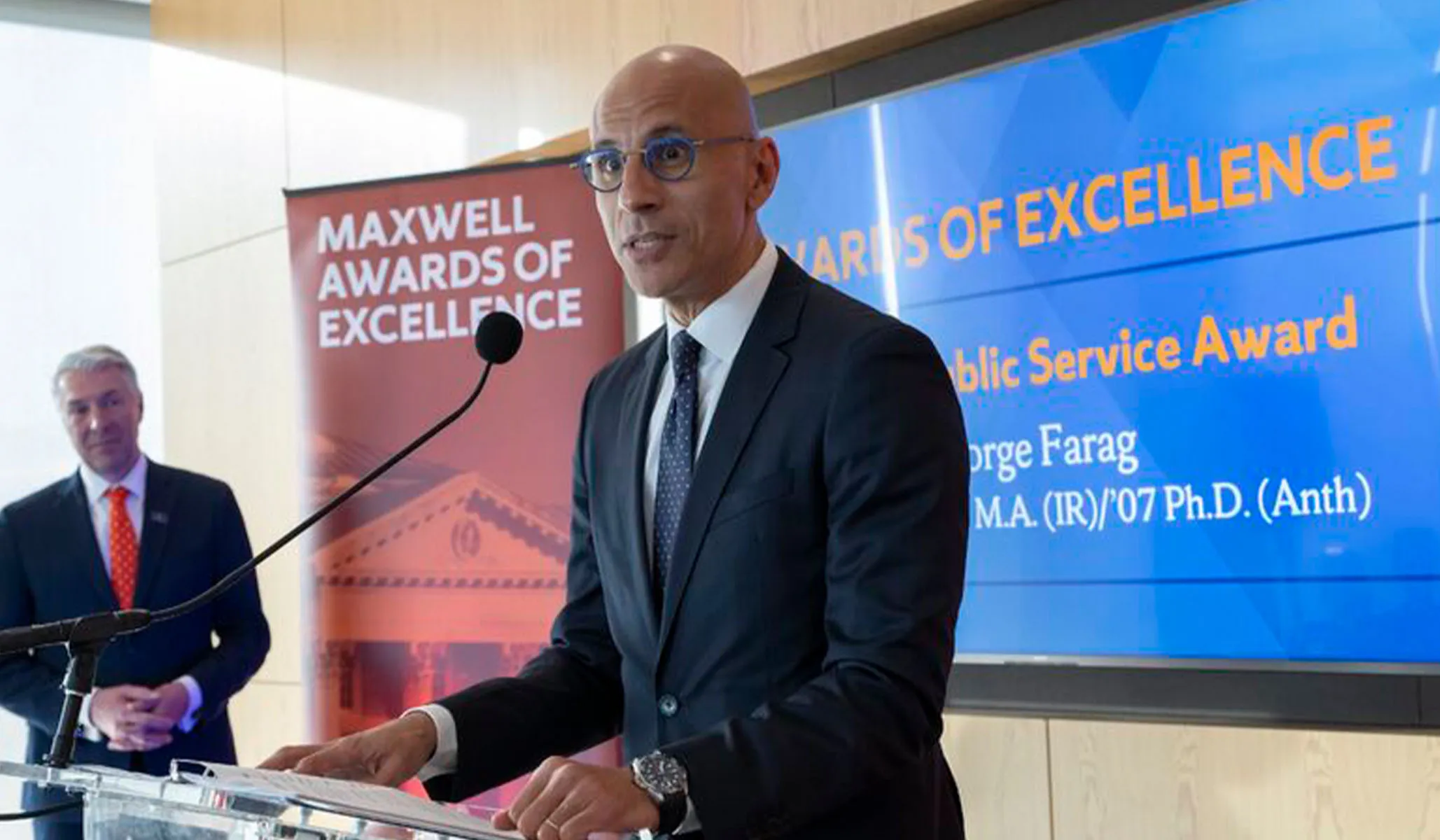
How 9/11 Led an Egyptian Immigrant to Become a U.S. Diplomat
When George Farag was a graduate student at Syracuse University in 2001, he met an investigator for the U.S. Foreign Service who told him he should consider joining the diplomatic corps because of his Egyptian background and his ability to speak Arabic.
Read more Roger Waters to Headline 9/11 Conspiracy Conference in NYC
At the time, Farag thought the idea was preposterous. He had been raised by a single mother in Jersey City after his family fled Egypt in 1986 in search of a better life. The family struggled to get by, with Farag’s mother working as a babysitter during the day and a bodega cashier at night. They relied on welfare services and pulled furniture and clothing out of discarded piles on the side of the street.
This, Farag believed, was not the background of a U.S. diplomat.
“I come from a family that doesn’t know anything about foreign policy,” he said, “and it didn’t make sense that a kid on welfare could become a United States diplomat.”
But Farag’s perspective shifted one month after the meeting, when an Egyptian terrorist led a group of al-Qaeda members in carrying out the deadly September 11 attacks on the World Trade Center and the Pentagon.
As an Egyptian immigrant, Farag felt he had something to prove.
“To be associated in that way with the lead terrorist of 9/11 was confusing,” he said. “I felt like I needed to do something. I had to serve the country that had given us a future.”
Having benefitted from the American dream himself, he didn’t just see 9/11 as an attack on an “abstraction called America — it was an attack on the institution that basically gave my family a future.”
Despite the family’s financial struggles, he found his American education opened doors for a future that he once didn’t believe possible. As a child, he attended local public schools. In eighth grade, a teacher saw academic promise in Farag and encouraged him to apply to a local magnet school.
“From there, she opened the door for me, and then other doors started opening,” he said, adding he later received scholarships to get his undergraduate and graduate degrees in finance.
So, after the attacks, he found the brochure the Foreign Service investigator had given him.
The events of September 11 “made me feel that I had to do something to demonstrate that that is not me. I did feel that I had something to provide and honestly, I continue to. That doesn’t go away — or at least it hasn’t gone away for me.”
Read more From Reagan to Trump: The GOP Has Changed — but Mike DeWine Hasn’t
After passing a series of exams and background checks, he was assigned to his first post in Bahrain in 2003, but he volunteered to serve in Najaf, Iraq, as one of the first American diplomats helping Iraqis adopt permanent democratic institutions while Saddam Hussein remained at large.
“It was a very dangerous moment to be in Iraq,” he recalls.
He lost eight colleagues and friends to insurgent ambushes during that time. On one occasion, a fellow American diplomat was trapped by an “enraged mob” of Iraqi men. Farag helped free his colleague from the mob — an action for which he is now nominated for the Department of State Award for Heroism.
He later went to Beirut, Lebanon. During his time there, war broke out between Hezbollah and Israel and he helped coordinate the evacuation of 15,000 Americans out of Lebanon. Most officers were ordered to evacuate the country, but Farag remained in Beirut as the only Arabic-speaking consul. He supported Ambassador Jeffrey Feltman as he negotiated the cease-fire that ended the 2006 Lebanon War.
In more recent years, he has consulted for the U.S. State Department on consular systems in the Middle East, North Africa, and South Asia.
He’s currently supporting consular crisis operations across 15 U.S. diplomatic missions during the U.S.–Iran conflict.
“America gave me a chance, giving my family a future, and it’s a debt that I’ve been trying to pay back throughout my career,” he said.
Today, as he looks back on more than 20 years of government service, he says he is as patriotic as ever — though his love for America looks different today than it did when he first arrived in New York on Halloween night in 1986 as an idealistic child.
His relationship with the country he has served dutifully for the last two decades is now more like a bond with a close family member: “You can love them and still want better for them. And I think that’s kind of my relationship with America.”
Read more Catholic Health-Care Providers Sue Illinois over Physician-Assisted Suicide Law

Related Posts
Dearborn Leaders Spent Taxpayer Funds to Promote Islam While Discriminating Against Christians and Jews, Lawsuit Alleges
Dem Fundraising Giant ActBlue Accepted Illegal Foreign Donations, Covered Up Evidence, House Report Says