From Reagan to Trump: The GOP Has Changed — but Mike DeWine Hasn’t
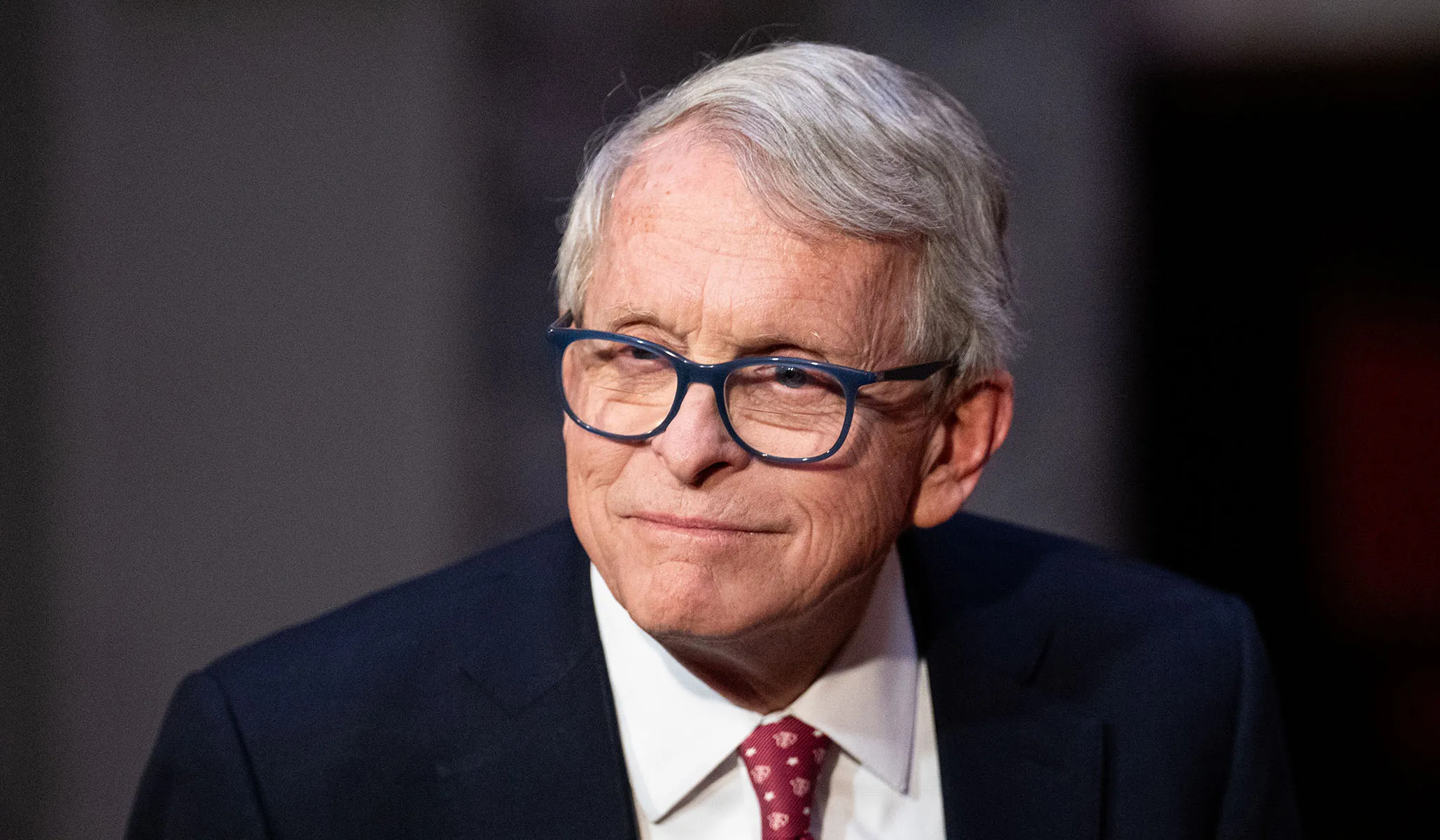
Columbus, Ohio — When Governor Mike DeWine was a junior congressman representing Ohio in the 1980s, President Ronald Reagan invited him to fly on Air Force One to Wright Patterson Air Force Base, which was in DeWine’s district.
Read more Catholic Health-Care Providers Sue Illinois over Physician-Assisted Suicide Law
After the plane landed, Reagan told DeWine, “Come on, Congressman, and walk out with me,” inviting him to do something presidents typically do alone or accompanied by the first lady.
“He knew how much it would mean for a young congressman to have news media show us coming off [the] plane together,” DeWine told National Review as he recounted his time with the Gipper. The governor still has the photo of him and Reagan waving and smiling as they disembarked from the plane.
Over 40 years later, DeWine is finishing up a political career that has led him from the state legislature to both chambers of the United States Congress and finally to the governor’s mansion.
Dewine represents a dying breed of politician in America. He chooses to do the quiet work of lawmaking rather than engage in incendiary rhetoric, and he’s willing to put partisan differences aside to work across the aisle. At 79 years old and having held elected office for over half his life, he’s also seen the development of the Republican Party from Ronald Reagan to Donald Trump. He reflected on his career in an interview with NR.
The governor has long been a dyed-in-the-wool conservative. When he was about 13, his family subscribed to NR, and he began reading William F. Buckley Jr.’s columns. “What Buckley was writing . . . seemed to me to make sense,” he said. A year or so later, he got a new dog and named him after Barry Goldwater — years before the Arizona senator mounted his run for the presidency. When Goldwater did run for the White House, DeWine went door-to-door campaigning for him as a high school student in his liberal town. “I’m not sure I picked up one vote,” he said.
DeWine would eventually run for office himself, beginning as a county prosecutor before serving in the state legislature and eventually winning election to the U.S. House of Representatives in 1982. After a few terms there, he became Ohio’s lieutenant governor and later represented his state in the Senate for twelve years until he lost to Sherrod Brown in 2006. In 2010, DeWine jumped back into the political arena and successfully ran twice to be Ohio’s attorney general before winning the governor’s mansion in 2018.
Though he is an avowed conservative, he is not a rigid ideologue. Asked what accomplishments he is most proud of, the father of eight named his work to improve the welfare of children, efforts that were often bipartisan.
“Politicians pay lip service to kids in their rhetoric, but, when it comes down to it, stuff just doesn’t get done for kids,” he said. “They don’t vote. It just doesn’t happen as much as it should.”
When he was a state senator, a grandfather came to him and recounted how a drunken driver had struck and killed his seven-year-old grandson as the boy got off his school bus. That inspired DeWine to take the lead in passing a law that combated driving under the influence. DeWine also touted his work in the U.S. Senate with Democratic Senator Chris Dodd of Connecticut to incentivize drug companies to figure out dosages for children, as well as adults, when they developed their products.
DeWine’s career in public office has allowed him to see the benefits and drawbacks of different elected offices, and his insight is particularly relevant as Congress endures times of drama and dysfunction. Historically, the Senate has been the next stop for successful governors, but the trend has begun to reverse, with three senators — Marsha Blackburn of Tennessee, Tommy Tuberville of Alabama, and Michael Bennet of Colorado — ditching the Senate to run for governor this year alone.
Some observers have attributed the pattern to dysfunction in Congress making the Senate look less appealing, but DeWine indicated that the governor’s mansion has long been more tempting than the Senate. He recounted a conversation he had with Senator John Ashcroft while serving in Congress’s upper chamber. Ashcroft, who had previously been governor of Missouri, observed the number of senators who had also been their state’s chief executive. “Any of these former governors here that tell you that the U.S. Senate is a better job than governor would lie to you about anything,” he told DeWine.
For his part, DeWine noted that his departure from the Senate was not voluntary, but he still said he liked being governor better. “You’re in the action every day, and a lot depends on you,” he said.
DeWine’s long engagement with politics has also allowed him to see the development of the conservative movement — from its early debates in NR, to its jumping off the magazine’s pages with Goldwater and Reagan, to its takeover by Trump in the past ten years.
Having been in major government offices under both Reagan and Trump, DeWine has seen the rise of populism firsthand. The trend has been particularly pronounced in Ohio. Before Trump came onto the scene, Ohio was a swing state, but the president has won it comfortably three times, in large part due to his ability to flip blue-collar voters who previously had voted for Democrats.
Read more Judge Declares Mistrial in Lindsay Clancy Murder Trial
“Trump spoke to the forgotten man,” said Greg Lawson, a senior research fellow at the Buckeye Institute, a conservative think tank in Ohio. “He spoke to the people in Youngstown, Ohio, or Steubenville, Ohio, and along the Pennsylvania border, where steel mills [have] basically become rusting hulks and a reminder of what Ohio once was, but now is not.”
The soft-spoken DeWine is a bit of an awkward fit in an age in which provocative statements and hyper-partisanship are often rewarded, but he has remained a fixture of the state, nevertheless. In the 2022 gubernatorial primary, he defeated two candidates who challenged him from his right flank — though their combined vote total was greater than his.
According to Lawson, part of DeWine’s staying power is his popularity with independents. “He just comes off like a guy who’s your uncle or your grandfather,” he said. “It just seems like he’s a safe pair of hands who’s going to just kind of take care of things.”
Speaking to NR, DeWine praised several pieces of Trump’s work, including his efforts on border security and nuclear energy. He also spoke highly of Trump’s ability to get Republicans to appeal to blue-collar workers by promising to protect or bring back their manufacturing jobs. “That has been a great movement forward,” he said. “Some of it’s policy, some of it’s rhetoric, but part of it is just letting them know, ‘Hey, we care.’”
Still, he did break with Trump on issues of trade and foreign policy, contrasting parts of the 45th and 47th president’s program with that of the 40th. “Reagan was for free trade — and Republicans after that. Trump has been [for] high tariffs,” DeWine said, adding, though, that it was a bit “unfair” to any president to guess where he would be on trade today amid changing circumstances. “Where would Reagan be today? I don’t think he’d be for high tariffs, but I do think he would be for pretty aggressive negotiations, which I think is really where I am.”
But DeWine was also skeptical of Trump’s posture toward Canada, noting that about 31 percent of his state’s exports go there. “A protracted trade war with Canada is certainly not good for Ohio,” he said.
He also drew a contrast between Reagan and Trump on foreign policy, pointing out their different feelings toward NATO. While Reagan was a strong supporter of the alliance, Trump has criticized it since he first ran for president. “I think you can make a good case that NATO has not paid its fair share,” DeWine said. “That’s different from some of the things that we’ve seen happen in foreign policy,” DeWine said. “I worry about that.”
Immigration may be the issue where DeWine is most out of place in today’s GOP. Though he praised Trump’s efforts to curb illegal immigration and deport violent criminals, DeWine was skeptical of expelling many immigrants whose only crime is crossing the border illegally, as the Republican Party has embraced Trump’s agenda of mass deportations.
The governor saw the excesses of populist immigration rhetoric firsthand during the 2024 cycle, when Trump and his running mate, JD Vance, spread false claims about Haitian migrants eating household pets in Springfield, Ohio, where DeWine was born. DeWine rebutted those claims at the time and eventually argued that the Republican ticket’s rhetoric “hurts the city and its people, and it hurts those who have spent their lives there.”
Today, DeWine points out that populist rhetoric targeting vulnerable immigrant populations is not unique to this era, noting that the Irish immigrants from whom he is descended came to America in the decades before the Civil War and encountered signs saying, “No Irish Need Apply.”
“Every group that’s come in, there’s been discrimination against it,” he said. “It’s not good, but my only point is, this is not new.”
Now, in his final months as governor, DeWine has chosen to make advocacy for immigrants in his state a priority. He once again finds himself defending Haitians in Ohio, opposing the administration’s move to end their Temporary Protected Status. He is also defending migrants more broadly, imploring Trump to take up the cause of immigration reform. In a New York Times op-ed published last month, DeWine argued that Trump’s successes on border security give him “the standing to lead an effort to reform our legal immigration system.”
Speaking to NR, he noted the high percentage of immigrant employees in Ohio’s workforce and expressed uneasiness about their “depopulation.” He noted specifically that about a third of home-health-care workers in the state were foreign-born.
“Some may be illegal, some may not,” DeWine said. “I don’t know. . . . I just think this is a real mistake to think our country is going to be better off without these people.”
Read more University of Washington Pays $600,000 to Professor After Losing Land Acknowledgment Fight

Related Posts
Dearborn Leaders Spent Taxpayer Funds to Promote Islam While Discriminating Against Christians and Jews, Lawsuit Alleges
Dem Fundraising Giant ActBlue Accepted Illegal Foreign Donations, Covered Up Evidence, House Report Says