The Midterms Will Test the Power of the MAGA Defectors
In a late-night Truth Social post on Friday, President Donald Trump attacked a group of MAGA apostates who have sharply criticized his military campaign in Iran.
Read more Seattle Times Columnist Resigns After Editors Spike Essay Defending Fairness in Women’s Sports
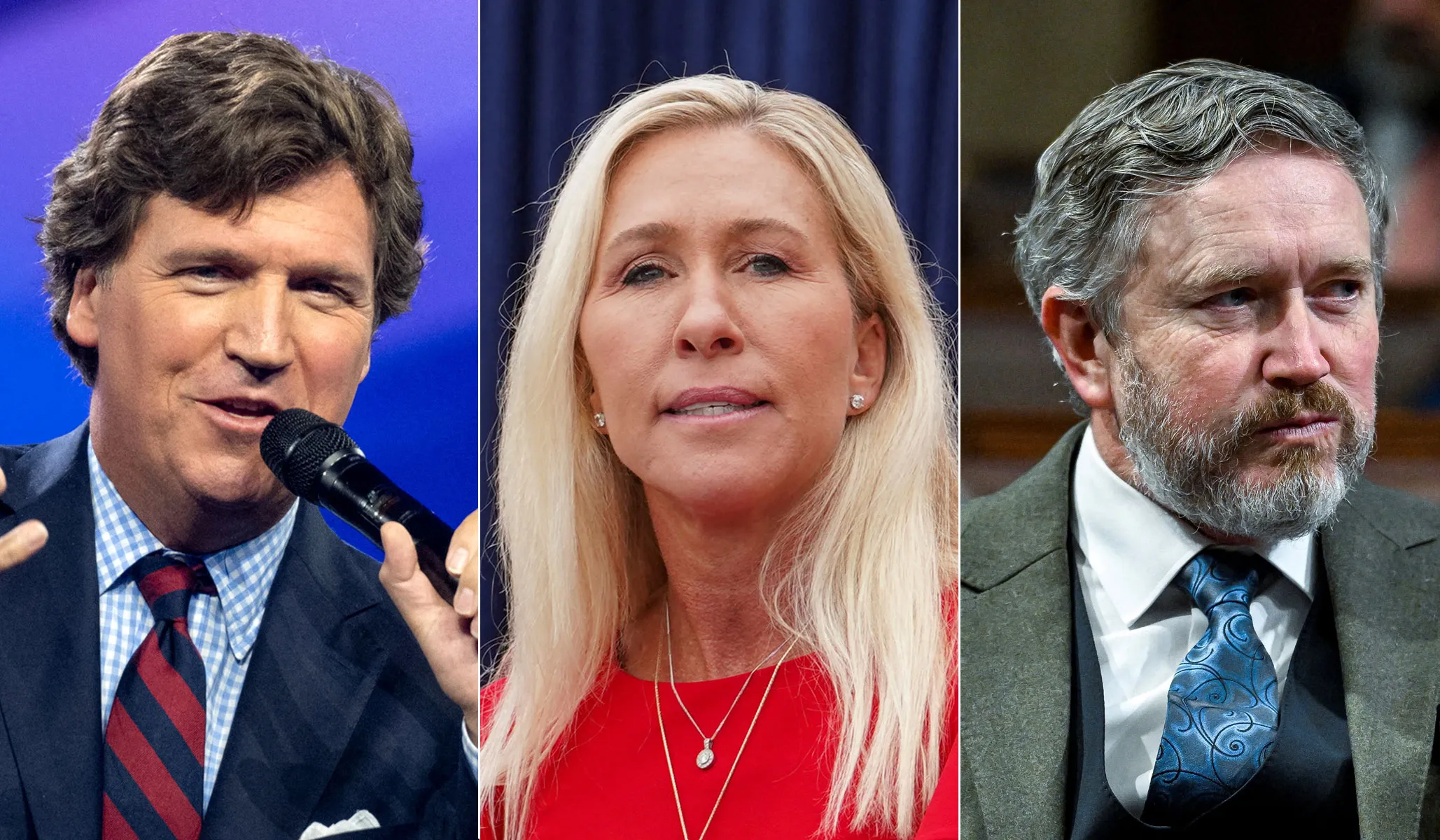
According to Trump, Tucker Carlson is “a very Low I.Q. individual,” while Marjorie Taylor Greene is “a highly neurotic young woman.” Meanwhile, Thomas Massie is “a failed politician, and a real JERK.”
Trump in his post also referenced a meeting earlier this month, where the excommunicated politicos gathered at Carlson’s Maine home to discuss the future of American politics. While the assembled GOP defectors did not mark the occasion by announcing the establishment of a third party, Carlson strongly hinted at it in a monologue posted after their meeting in which he laid out a statement of ten principles which the “uniparty” has forsaken.
Carlson and his house guests — Greene, Massie, as well as Joe Kent — have different points of emphasis in explaining why they broke with Trump, but they all share in common a belief that the war with Iran represents a total betrayal of the voters who put Trump back in office. They also all believe — or claim to believe — that Israel manipulated the U.S. into the war.
Each of the defectors has a considerable following on social media, and Carlson has a massive podcast audience. His monologue episode laying out the statement of principles — titled “It’s Time to Save America” — has been viewed 1.4 million times on YouTube. A photo of the gathering Greene posted on X has been viewed more than 10 million times.
“We said no more foreign wars and we meant it and supported Donald Trump because he made that promise. But he’s betrayed us all,” Greene wrote in the post. “The movement has begun.”
Kent, who resigned earlier this year from his post as director of the National Counterterrorism Center, said in a follow-up interview that the group had come to a consensus decision to start a third party and had tried unsuccessfully to draft Carlson as a presidential candidate.
Trump in his Truth Social post tried to minimize the group’s stature. “What a team this would be, THREE LOSERS, and a pocketful of change!” he wrote. But he did acknowledge that if Carlson were to run for office, he “could probably take a couple of points away from whatever the Republican ticket happens to be.”
None of those Trump attacked are on the ballot this fall, but with the midterms looming, are Republicans worried that Carlson and company might use their influence to turn their collective audience — partly composed of the working-class young men who helped put Trump back in office — against the GOP?
To hear most professional Republicans tell it, the answer is a resounding “no.”
“President Trump has been clear: they are not part of the MAGA movement anymore,” Sam Markstein, political director of the Republican Jewish Coalition, told National Review of Carlson and his friends. People in Trump’s orbit who spoke to Politico similarly minimized their impact.
By focusing on the extreme cultural positions embraced by the Democrats, Republican leaders in Washington and across the swing states believe they can counter young voters’ discontent with the Iran war.
“I suppose there may be some younger/working class men who may consider staying home or voting Democrat” over Israel and the Iran war. “That being said, anyone who is really paying attention recognizes how radical the Democrat candidates’ positions are and would be frightened by them,” said Fred Kappus, who, as chairman of the Republican Party of Eau Claire County in Wisconsin, is working to help GOP Representative Derrick Van Orden win reelection and Representative Tom Tiffany take the governor’s mansion.
Across the lake, Norm Shinkle serves as the co-chair of the Republican Party in Ingham County, Mich., where he is tasked with helping Representative Tom Barrett hold on to a pivotal swing district based in Lansing and supporting GOP Senate nominee Mike Rogers against his Democratic opponent, Abdul El-Sayed. He conceded that young people — including a young man he works out with at the local gym — are upset with Trump’s decision to go to war, but he attributes their opposition to a lack of understanding of the threat posed by Iran that can be corrected. “If people don’t comprehend that, it’s easy to be against the war,” he told NR.
These Republicans have some reason to project the confidence that they do. This would hardly be the first time that a populist backlash against military action abroad has arisen in the GOP. The most famous anti-war GOP disruptor is Pat Buchanan, who, although he won the 1996 New Hampshire primary, lost the nomination to Bob Dole. Four years later, Buchanan ran as the nominee of the Reform Party, and he did not stop Republicans from winning the White House and holding on to the House of Representatives and Senate. (Though those wins did come in an election cycle that saw a razor-thin presidential race and Democratic gains in both chambers.)
This year, Republican voters have not shown that they are overly enthusiastic about anti-Israel candidates, despite the success of anti-Israel commentators in amassing large online followings. Massie himself lost to a challenger supported by AIPAC, and virulently anti-Israel candidates James Fishback and Dan Bilzerian both lost their Republican primaries in Florida to more mainstream candidates.
Meanwhile, in addition to El-Sayed being the Democratic nominee for Senate in Michigan, multiple Democrats who have accused Israel of genocide have won primaries in blue districts, sometimes prevailing over incumbents.
Read more Scientist Behind Wuhan Bat Research Thanked Fauci Aide for Helping Shut Down Lab-Leak Theory
What’s more, even if many young, working-class men do stay home this year, it’s not necessarily because of Israel and Iran. Chances are, they likely wouldn’t have voted anyway.
“Most of these people didn’t vote in ’22 or’ 18 or ’14, if they were old enough,” Brent Buchanan, CEO of Cygnal, a polling firm based in the Washington, D.C., area, told NR. “But that, to me, gets lost in the story. This is not some reliable voting bloc that is waffling off of the president and Republicans.”
Still, there could be some hazards related to foreign policy issues. Curt Mills, executive director of the American Conservative, a magazine founded in part by Pat Buchanan, argued that if Republicans lose the Senate, it will likely be because they lose races in red states that Trump won two years ago, such as Ohio, Texas, and Alaska.
“The Republicans are messing it up, and everybody knows it’s the Iran war,” Mills told NR.
Not all Republican voters are thrilled with a pro-Israel Republican Party with a strong military presence in the Middle East. After all, 45 percent of voters in Massie’s primary chose him. Fishback and Bilzerian also received about 10 percent and 18 percent in their respective races — far from enough support to win, but enough to prompt concern in some observers.
Polling data provides a similar Rorschach test. Republican voters are generally pretty supportive of Israel, but there is a contingent that does not share the enthusiasm. In a of likely Republican primary voters conducted by Echelon Insights earlier this year, 64 percent had a favorable view of Israel, while 22 percent had an unfavorable one. Polling from Pew Research has also found that Republicans under 50 are remarkably less supportive of the Jewish state than older members of their party, with a majority of those ages 18–49 holding an unfavorable view toward Israel in a March survey.
Cygnal’s polling has also identified a cohort of Republicans in the Trump 2024 coalition that is slipping a bit and could be at risk of abandoning the GOP altogether over the Trump administration’s foreign policy moves. The firm’s identified about a quarter of Trump’s voters from last cycle who, though they dislike the Democratic Party, are no longer sold on the GOP. This group is generally younger and less attached to Trump, and those in it prioritize the economy over other issues.
According to Brent Buchanan, it is not so much that these people specifically disapprove of the war in Iran. Rather, they feel they have been given a raw deal in the economic and cultural spaces back home, so they do not want their leaders to focus on issues abroad.
“They don’t like any U.S. engagement outside of the U.S.,” Brent Buchanan said. “Their life sucks so much that they really don’t care what happens outside of the Atlantic and Pacific Oceans.”
It’s unclear just how popular Carlson’s views are within the broader Republican electorate, but his turn against Trump and attacks on Israel have gone over great with podcast listeners: “In the eight and a half weeks following the outbreak of the conflict, Tucker Carlson’s content generated 1.53 billion views across social media and podcast platforms, representing an increase of more than 101% compared to the prior eight-week period,” Carlson’s network crowed in an April press release which attributes the spike to increased youth engagement, particularly on platforms such as Instagram and TikTok.
Carlson has been joined in relentlessly criticizing the war by Joe Rogan and Theo Von, two massively popular podcasters who helped boost Trump in 2024. Carlson, however, is more politically oriented than Von and Rogan, and he could provide a vehicle to channel the discontent over the war, which Trump began after promising to stay out of conflict on the campaign trail.
“Tucker is clearly representative of the most ideological Trump 2.0 set,” said Marshall Kosloff, a senior fellow at the Niskanen Center who hosts a podcast that explores current political realignment. “The war in Iran is not compatible with their understanding of what the administration was going to be about, so it’s a very ideological opposition.”
If the GOP does poorly this fall, that could incentivize party leaders to rethink some of their foreign policy decisions, according to Mills.
“I actually think if they do get eviscerated that could be a good thing because it will imply to the Republicans they need to take some cold medicine and some black coffee and reform themselves,” Mills said, stressing that his magazine, which is published by a nonprofit, does not endorse specific candidates.
“Any Senate candidate or House candidate who’s running full-throatedly on the Iran war, I think, should obviously be defeated,” he added.

Related Posts
Top Virginia Democrat Louise Lucas Charged in Public Corruption, Drug Trafficking Case

Court Slaps Down NYC’s Latest Attempt to Punish Energy Companies for Climate Change