Amy Coney Barrett Describes Living Under Constant Threat, Urges Lawmakers to Increase Security for Justices
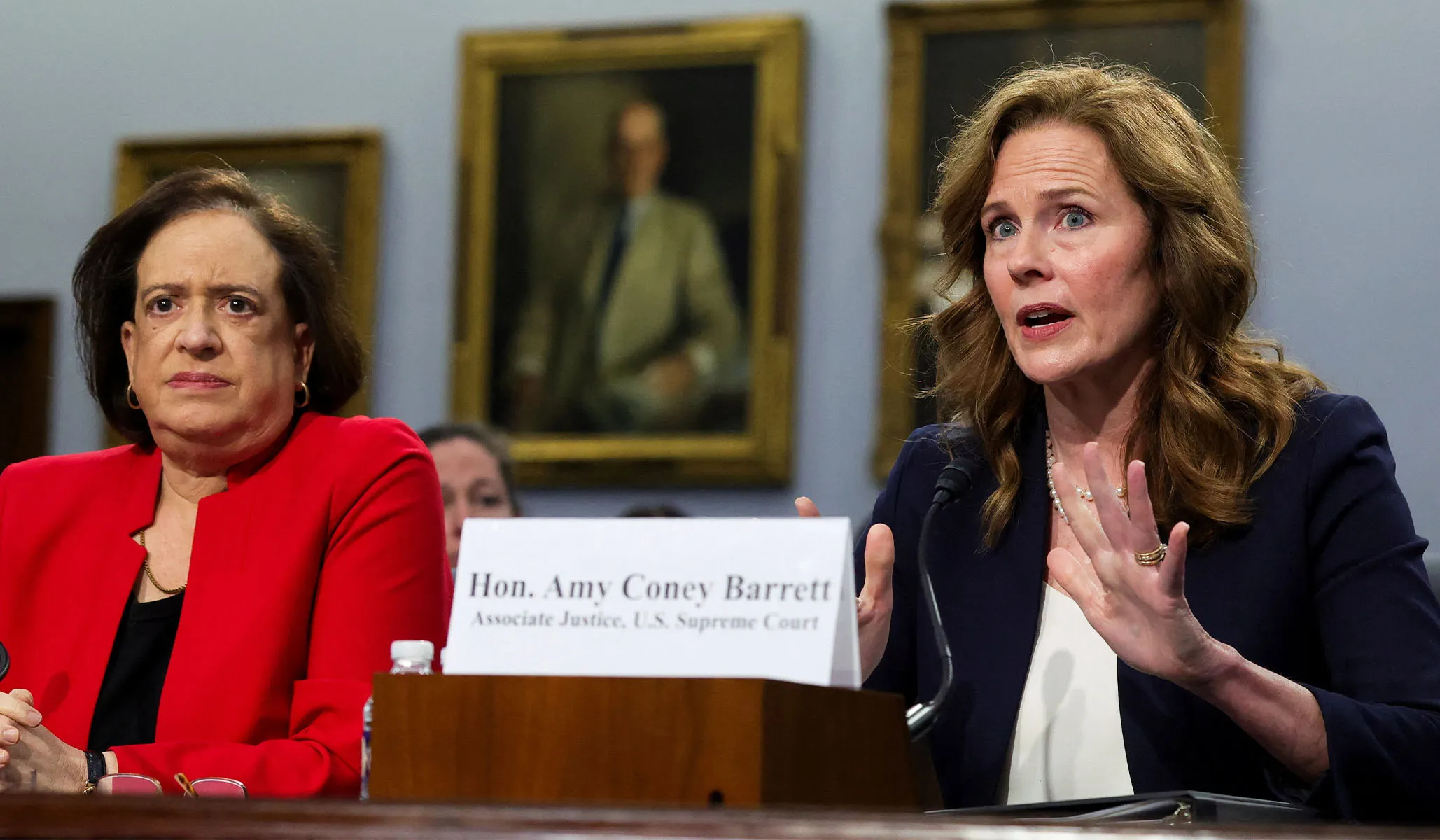
Justice Amy Coney Barrett spoke publicly for the first time on Tuesday about a swatting attempt at her home in May as she testified before Congress about the need for increased security funding for the Supreme Court.
Read more Women Harmed by Chemical Abortions Urge Todd Blanche to Settle Mail-Order Abortion Case
Barrett and Justice Elena Kagan appeared before a House appropriations panel on Tuesday — the first time a sitting justice has appeared before Congress since 2019. The pair noted threats against the High Court were up 25 percent last year, and are expected to rise 38 percent this year.
“Those statistics sound abstract, but being on the receiving end of them is not,” Barrett testified, going on to explain how the threats have impacted her and her family.
“They have required me to — and my children — to think about and see things that children should not have to see or think about,” she said, noting her security detail sent her home with a bulletproof vest at the time of the Dobbs leak in 2022.
When she brought the vest into her home and set it in her bedroom, her 12-year-old son “wanted to know what it was and why I had it.”
“I didn’t know how to respond, because maybe I lack imagination, but I didn’t expect that performing this service was going to put me in the position of explaining to my children what a bulletproof vest was and why I had to wear one,” added Barrett, a mother of seven children.
She went on to describe how one of her teenage sons opened the door to go out with friends just six weeks ago “and saw in our street it was full of police cars who had responded to a false report of gunshots and raised voices in my home.”
“I was very, very grateful that I had Supreme Court police outside my home because they were able to stop and meet with and explain to the county police that it had been a false alarm and so the police did not actually attempt to enter our home,” Barrett said of the “swatting” attempt.
Last month, authorities in Fairfax County, Va., confirmed in a statement to National Review that they had responded to a “swatting” attempt at Barrett’s home.
“Yesterday evening at approximately 9:02 p.m., officers responded to a swatting call at the residence of U.S. Supreme Court Justice in Fairfax County,” county police said in a statement to NR. Swatting refers to the practice of making false emergency calls to draw a heavy police response.
“The call was received through the department’s non-emergency line,” the statement adds. “Officers immediately coordinated with Supreme Court Police personnel assigned to the residence and quickly determined that the report was fictitious. No additional police resources were utilized.”
“Swatting,” or falsely reporting violent activity at the residence of a targeted individual, has become a popular tactic used by individuals looking to harm a public figure or create a dangerous disruption at their home. The tactic has been used against dozens of members of Congress as well as many celebrities.
Barrett on Tuesday went on to describe receiving “threatening anonymous deliveries designed to intimidate and harass” her and her fellow justices. The packages, she said, are often sent in the name of Daniel Anderl, the 20-year-old son of U.S. District Court Judge Esther Salas who was fatally shot by a disgruntled lawyer who opened fire at Salas’s New Jersey home in 2020. The killer, Roy Den Hollander, was targeting Salas when he approached the home disguised as a FedEx delivery driver and shot Salas’s son and husband, who opened the door instead.
“So I think the message on these deliveries being sent in his name is clear,” Barrett said. “As Justice Kagan said federal judges across the country throughout the judiciary including the Supreme Court continue to do their jobs without fear or favor but the threat level is really high.”
Read more South Carolina Governor Appoints Lindsey Graham’s Sister to Replace Late Senator
Kagan on Tuesday said the Supreme Court is requesting an addition $14 million in its 2027 fiscal budget for salaries and expenses — a 7 percent increase from the year prior. Over the last five years, the Court’s funding needs have grown an average of 15 percent per year, she said, almost entirely due to rising security expenses.
Last year, the responsibility for residential security for the justices was shifted from the U.S. Marshal service to the Supreme Court police.
“Our strategy has been consistent across security functions: expand incrementally but effectively to meet evolving security challenges,” Kagan said.
“For some of us those threats have come very close, and all of us live with the knowledge that they may again materialize. But as the chief justice has said, all members of the court continue to do their jobs as they believe legally right adjudicating cases without fear or favor.”
Barrett and other conservatives on the Supreme Court have previously been targeted by leftist protesters and advocacy groups, including most notably in June 2022, in the lead up to, and the aftermath of, the Court’s Dobbs decision, which overturned Roe v. Wade.
After the leak of the Dobbs draft opinion, a California man attempted to assassinate Supreme Court Justice Brett Kavanaugh. Nicholas John Roske, who has since been sentenced to eight years in prison for the crime, was detained by police outside Kavanaugh’s home in Maryland.
Roske called 911 himself because he was having suicidal thoughts. He told a dispatcher he had come “from California to kill a specific” Supreme Court justice, police said.
In May of this year, shortly before Barrett’s home was targeted by the swatting attempt, Chief Justice John Roberts sought to change how the public perceives the Court.
“I think at a very basic level, people think we’re making policy decisions, [that] we’re saying we think this is what things should be as opposed to this is what the law provides,” Roberts said. “I think they view us as truly political actors, which I don’t think is an accurate understanding of what we do. I would say that’s the main difficulty.”
“We’re not simply part of the political process, and there’s a reason for that, and I’m not sure people grasp that as much as is appropriate,” Roberts said.
He went on to argue that criticism over the Court’s decision should focus solely on legal merit, not on the justices as individuals.
“As soon as that happens, that’s not appropriate, and it can lead to very serious problems,” he said.