Coming Soon: Humanity’s First Outpost in Deep Space
What once seemed like science fiction is now within reach, as NASA looks to establish an enduring human presence on the Moon in the next decade.
NASA’s Moon Base is on track to become the first permanent human settlement in the solar system by the early 2030s.
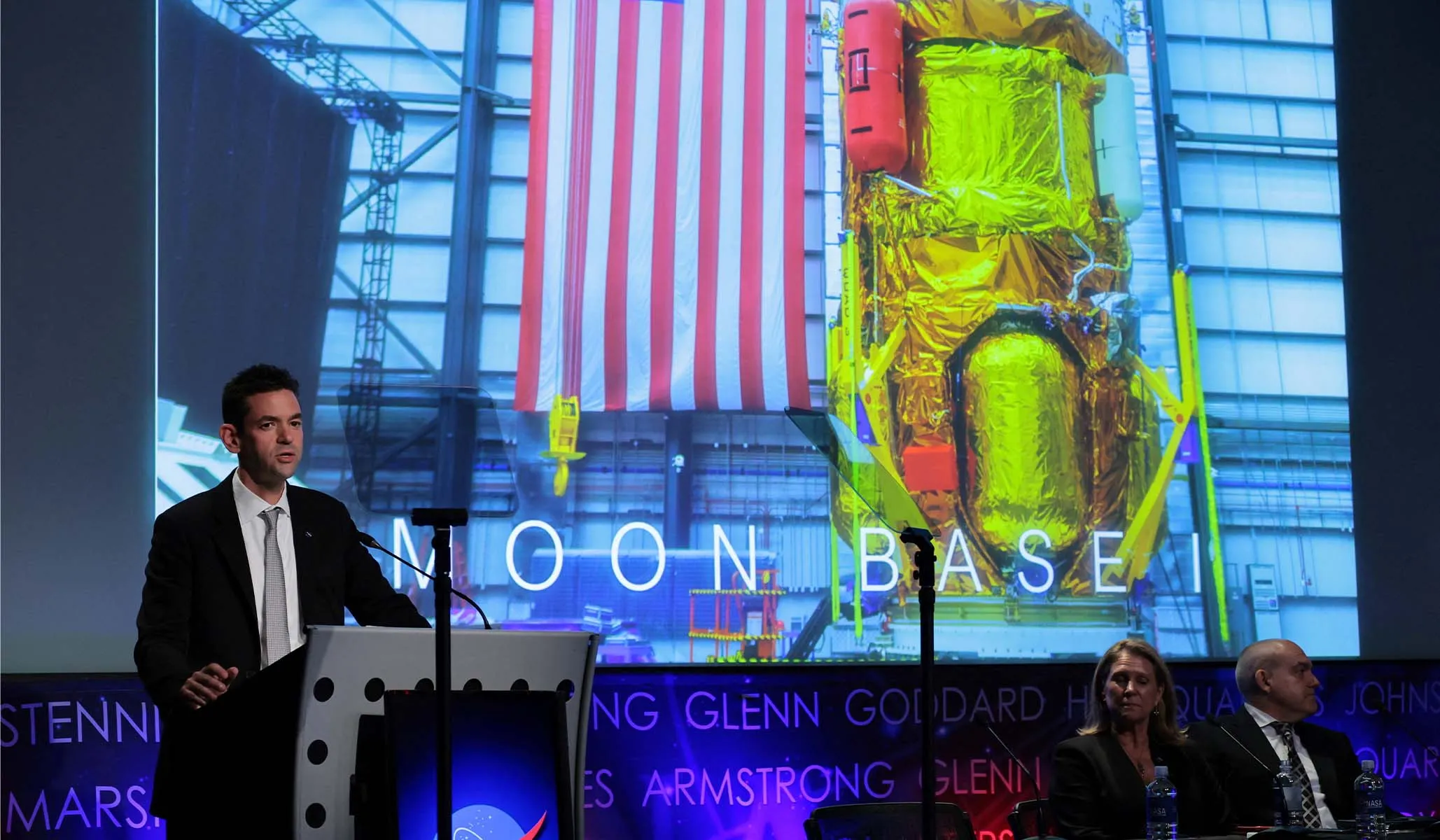
“This will be humanity’s first outpost in deep space,” Carlos García-Galán, program executive of Moon Base, told National Review. “It is a huge step forward in our capabilities to live and work and basically be able to push the boundaries in space.”
Located 238,855 miles from Earth, Moon Base will serve as a center for scientific research and technological development. The mission’s initial all-robot crew could launch as soon as fall 2026.
García-Galán sees the base as a critical step toward developing the technology required for missions to other planets, notably to Mars.
“I’ve helped build the Space Station. I’ve helped design the Orion spacecraft,” he said. “But this will take us to the next level.”
NASA’s plans for Moon Base were first announced on March 24, presented as an effort to establish the country’s leadership in space and pursue President Trump’s National Space Policy. In his December 18, 2025 executive order, the president said that taking the lead in space exploration was a vital symbol of “national vision and willpower” and a way to better promote America’s security and longevity. A lunar outpost was the top objective listed in the order.
The Moon Base mission focuses specifically on the South Pole of the moon because it is best for NASA’s specific scientific objectives. Beyond simply illustrating American achievement, these goals include testing advanced space exploration technologies, working with unique natural resources, establishing a center for scientific research, creating a permanent location for human settlement, and preparing to send a crew to Mars.
García-Galán said the prospect of meeting these scientific objectives is both exciting and challenging because the illumination from the sun causes stark differences in temperature on the moon. There can be “hundreds of degrees” of temperature difference between areas in the sun, the shade or areas cast in permanent shadows.
“We know very little about that area and how to operate in that area, so every asset that we put on the surface, every minute that we’re moving a rover around or have an astronaut exploring, is going to be packed with learning,” he said. “Start simple, learn and build up to higher capability.”
The mission will play out in three phases: the experimentation and discovery phase, an early habitation phase, and an ongoing human settlement phase.
The first phase begins now and lasts until roughly 2029, characterized by a fast chain of robotic missions scouring out the moon’s South Pole.
From 2029 to 2032, the second phase will center around the construction of semi-permanent structures on the base along with advancements in solar and nuclear power systems, advanced rovers, and a range of other major preparations for human settlement.
The third phase begins in 2032 and has no set end. Various crews will rotate through the settlement and there will be as many as 38 tons of various types of cargo delivered to the base annually.
Developments in fission power technologies will be able to provide settlers on the moon with a long-lasting, dependable source of energy. In addition, NASA scientists suggest that lunar regolith, unconsolidated and fragmented surface-level material on the moon, could be used for functions like construction, water sourcing, and plant growth.
Read more Elon Musk’s Net Worth Soars to $1.1 Trillion as SpaceX Goes Public
The Moon Base is part of NASA’s broader Artemis Program.
The Artemis I mission launched on November 6, 2022 as a 25-day uncrewed mission. Its purpose was to test the combination of an Orion spacecraft with upgraded exploration ground systems and the Space Launch System rocket.
Artemis II launched on April 1 for a ten-day voyage, focusing specifically on the far side of the moon. “They were able to identify a bunch of targets, which gave us new signs that we didn’t even think of just because they were there looking at it with their own eyes,” García-Galán said.
On Tuesday, NASA announced its crew and core objectives for the 2027 Artemis III mission, the final spaceflight mission before Artemis IV will take crew members to the moon’s South Pole in 2028. The focus of Artemis III is conducting critical trials and exploration in preparation both for Moon Base and an eventual Mars landing. NASA says that the Artemis III mission, expected to last two weeks, will involve “launching the world’s most powerful rockets in short order” and will test various Blue Origin and SpaceX landers.
Due to the scale of the project, NASA is collaborating with several major industry partners to establish Moon Base.
On June 2, Voyager Technologies acquired the lunar power and delivery company Astrobotic Technology, Inc., as part of the company’s effort to support the Artemis program.
“We are building the infrastructure foundation that will make America’s permanent presence on the Moon a reality,” said Dylan Taylor, Voyager’s Chairman and CEO, in a statement on the Voyager website. Voyager is responsible for the power infrastructure on the moon as well as logistics like building rovers and landers for NASA.
Firefly Aerospace is another one of NASA’s subcontractors and is specifically responsible for supplying propulsive drones and an Elytra spacecraft for the mission.
Astrolab and Lunar Outpost are supplying NASA with unique adaptations of lunar terrain vehicles, and Blue Origin will be delivering them to the South Pole of the moon.
The project also spans continents, including international partners in countries like Japan, Canada, and Italy. As with all other moon missions, Moon Base is subject to the Artemis Accords. First adopted in October 2020, the Artemis Accords are an internationally agreed upon set of principles for space exploration and the utilization of its resources. Sixty-seven nations have signed the accords.
This vision to settle the moon has been around for centuries. In 2010, NASA’s Constellation Program, launched to bring humans back to the moon, was cancelled by the U.S. government. The proposed national in 2011 attributed this decision to the Obama administration and said the program was “based largely on existing technologies and was over budget, behind schedule, and lacking in innovation.”
NASA was not prepared for such an ambitious mission then, but García-Galán believes it is now. “Evolution will be required, but all the pieces are already available,” he said, citing NASA’s increased industrial capacity, the durability of its materials in the face of the moon’s long, frigid nights, and decades of discoveries on the International Space Station.
García-Galán believes it is critically important to keep Americans updated on the mission.
“We definitely want the public to follow along with us,” he said. “This is not our moon base. This is also your moon base. This is humanity’s moon base.”
Read more ‘Independent’ Senate Candidates Are Actually Relying on ActBlue, Dem Donations in Key Races

Related Posts

Top Virginia Democrat Louise Lucas Charged in Public Corruption, Drug Trafficking Case

Court Slaps Down NYC’s Latest Attempt to Punish Energy Companies for Climate Change