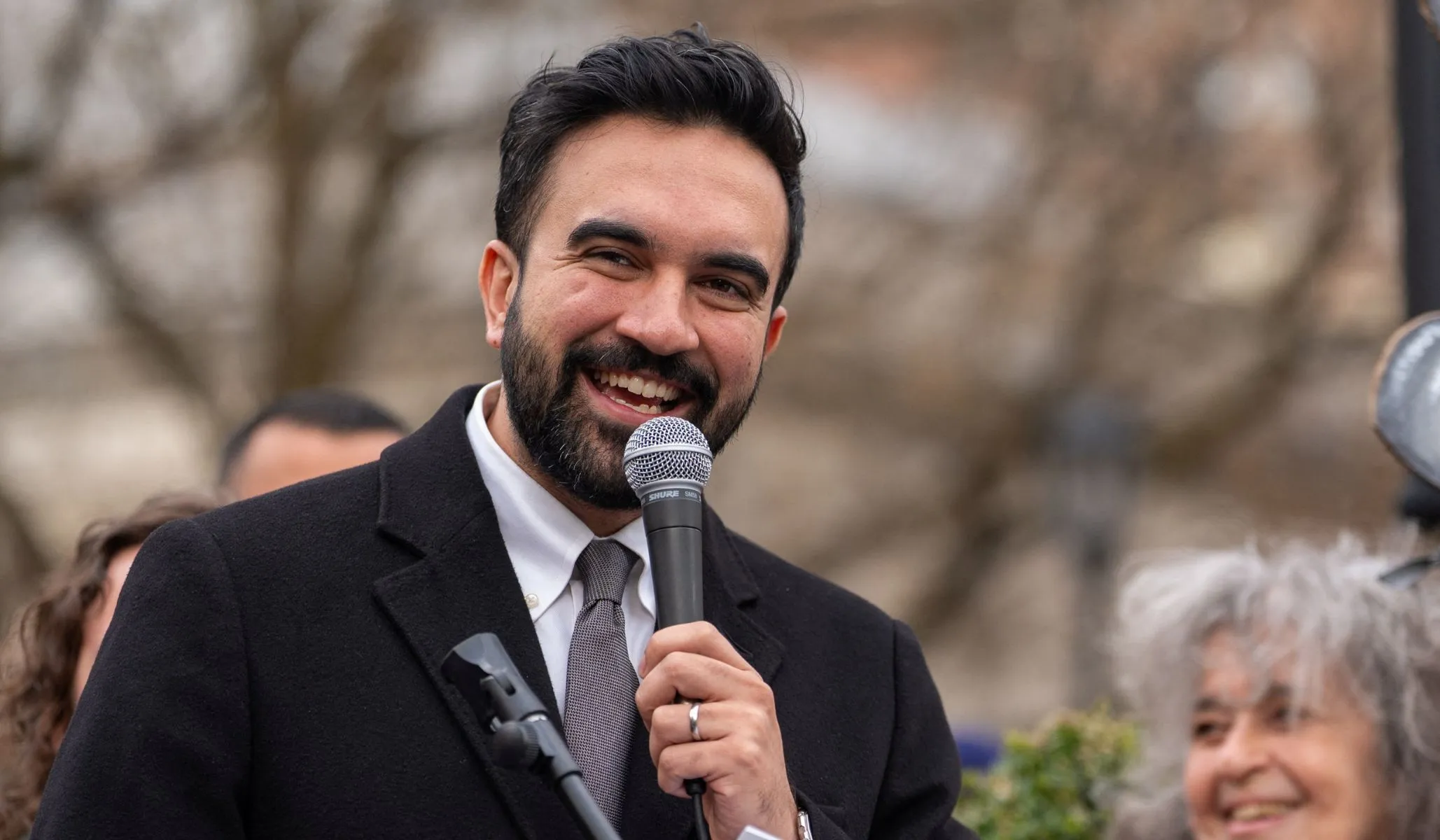
Mamdani Announces First City-Owned Grocery Store Will Open Next Year
New York City’s first city-owned grocery store will open in the Bronx neighborhood of Hunts Point next year, New York City Mayor Zohran Mamdani announced Monday, making good on a high-profile campaign promise to expand the role of government in the Big Apple.
Read more Colbert Receives a Hero’s Sendoff
The mayor’s plan includes five city-owned grocery stores, one in each borough. He previously announced the city’s first location set to be at La Marqueta in East Harlem in Manhattan, with hopes to open the store by 2029. The new store will be within Representative Alexandria Ocasio-Cortez’s (D., N.Y.) district — a staunch defender of the government grocery plan.
“With only one full service supermarket within a quarter mile, thousands of New Yorkers only have only limited options,” Mamdani said in a press conference Monday. “We are here together today to change that and to chart a new course.”
“In these stores, prices will be cheaper, workers will be paid fairly and treated with dignity,” Mamdani said.
The store, however, requires funding approval from City Council, and according to the mayor’s plan, includes $70 million in capital to fund the project.
Sites are chose based on “grocery store density, income inadequacy and population density,” according to the mayor’s office.
Compare Foods Supermarket is located a quarter mile from the city’s newest planned grocery store location.
The 20,000 square foot market space is set to be located at the Peninsula, an affordable housing development in the Bronx. The area is said to have a high poverty rate. It is set to include 740 housing units, ranging from $740 to $2,298 per month, with community spaces and retail space for the mayor’s city-owned grocery store.
“Making sure every New Yorker can buy fresh, affordable groceries in their own neighborhood is a key part of our affordability agenda,” Mamdani said in a statement. “We are proud to begin this work in the South Bronx and remain committed to opening a store in every borough before the end of our first term.”
Frank Garcia, the chairman of the Multicultural Business Coalition, strongly opposes the city-owned grocery stores, and has raised at least $1 million through his nonprofit to campaign against the plan.
Read more Colbert Receives a Hero’s Sendoff
“This is a waste of our tax dollars,” Garcia told The New York Times. “The mayor should sit down with us, and we can give him a real plan to bring down prices.”
Garcia’s group plans to hold a rally at City Hall at the end of May, on the same day the city is holding a hearing on the Economic Development Corporation, the group handling the city-owned grocery store plan. Next steps could include filing a lawsuit against the city to stop the grocery stores, according to Garcia.
Critics are concerned city run grocery stores will push out local bodega owners and chaos in the city.
“These stores are going to get jam packed, they’re only four or five in the entire city of 8 million people,” Fernando Mateo with United Bodegas of America previously told ABC7. “What do you expect is going to happen? You’re going to have people rushing to these stores early in the morning to late at night, waiting on long lines. You know, it’s going to be more turmoil than anything else. It’s a great punch line for him and for the socialist movement. But New York is not a socialist city.”
Mamdani said he will “use the power of government” to lower prices of groceries for New Yorkers.
“Standing here this morning, I cannot help but think of the word’s of our fortieth president, Ronald Reagan. He famously said, ‘The nine most terrifying words in the English language are: I’m from the government, and I’m here to help,’” Mamdani said. “It’s a good quote, but I disagree. I think nine more terrifying words are actually ‘I worked all day and can’t feed my family.’”
Mamdani has consistently blamed high grocery prices on greedy corporations despite the famously thin margins that obtain in the industry: The average store making just a 1.6 percent profit, according to the Food Industry Association.
Government-run stores have been tried and failed elsewhere. A city-operated store in Baldwin, Florida closed in 2024 after five years, because it consistently failed to reach the break-even point.
