Cambridge Prof Fighting Plagiarism Allegations Seems to Have Fabricated Major U.S. University Affiliation
Jason Arday, who received media attention for becoming the youngest black professor ever at the University of Cambridge in England, has recently come under scrutiny for allegedly fabricating his professional affiliations and plagiarizing his academic work.
Read more Cornyn Says He Now Opposes Scrapping the Filibuster
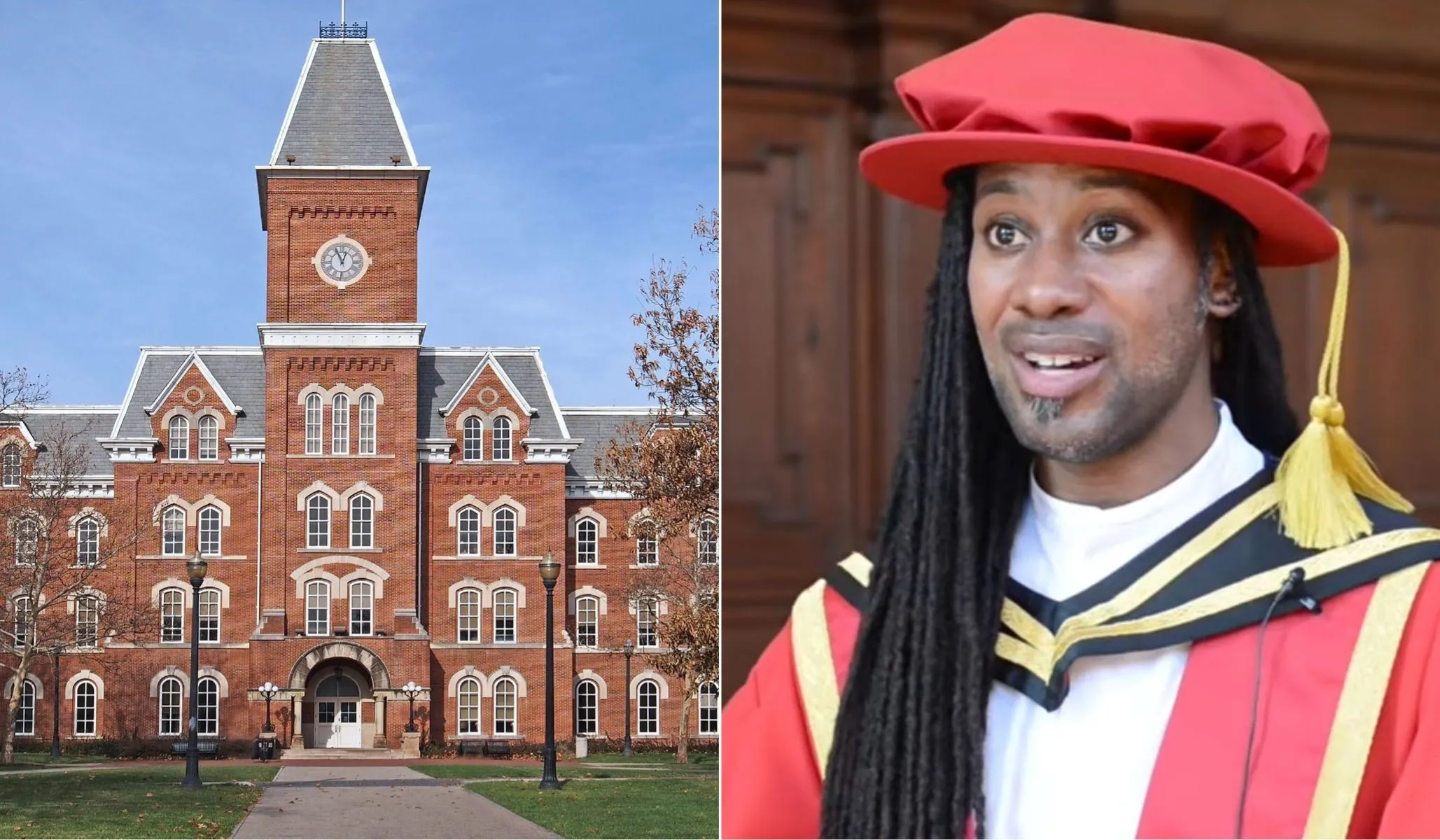
Now, another line on his résumé is in doubt: Arday says on his official faculty website that he is a visiting professor at The Ohio State University in the Office of Diversity and Inclusion — but Ohio State’s DEI office shuttered in 2025, and the school said he was never an employee.
“We have no record of an employee by that name,” Ohio State University spokesman Benjamin Johnson told National Review on Tuesday.
Ohio State previously announced that its Office of Diversity and Inclusion would close, effective February 28, 2025. Arday did not respond to a request for comment.
The Ohio State revelation comes after The Herald, a Scottish newspaper, revealed earlier this week that Arday’s claim to have worked as a visiting professor at the University of Glasgow in its School of Education was false.
Recent investigations have revealed that Arday, who became Cambridge’s youngest black professor ever at the age of 37 in 2023, plagiarized some of his academic work and fabricated many of his achievements.
Controversy surrounding Arday began when Nathan Cofnas, a postdoctoral researcher at Ghent University in Belgium, published the article “DEI Fraud and Cover-Up at Cambridge” on his personal blog on July 21. The article details instances of plagiarism throughout Arday’s academic work, including in his doctoral dissertation.
“If one removes the apparently plagiarized material from his record, there is little or no real scholarship,” Cofnas wrote of Arday. Cofnas previously held a research position with Emmanuel College at the University of Cambridge, which the college terminated because of his previous writings, some of which focused on IQ differences across racial groups and disparate outcomes in meritocracies. One of Cofnas’s particularly controversial claims was that the number of black students at Harvard would fall below 1 percent if admissions were strictly meritocratic, although that figure was drawn from an internal report produced by Harvard University’s own Office of Institutional Research, a document that Harvard’s lawyers later described as “incomplete, preliminary, and based on limited inputs.” Cofnas sued Emmanuel College and lost, although the university itself had previously confirmed that his speech was lawful and did not contravene the institution’s free-speech policies.
Given the previous controversies surrounding Cofnas’s writing on race, Arday and his supporters have attempted to brand the plagiarism accusations as part of a racist smear campaign. Liverpool John Moores University, which awarded Arday his Ph.D. in 2016, says it previously reviewed the allegations and concluded there were instances of “honest and reasonable error.” The review panel cleared Arday.
“There has been, since I arrived at Cambridge, a very well orchestrated and co-ordinated campaign to unseat me from my position,” Arday said in a recent interview. “The motive is racially motivated. I think there’s a reason why it’s me, and I do think that reason is aligned to ableism and racism.”
But the evidence against him is piling up. The Telegraph reports that 188 sentences in Arday’s doctoral dissertation were identical or highly similar to the work of Paula Zwozdiak-Myers. And the issues are not limited to his dissertation.
Some academic journals seemingly became aware that they had published Arday’s work that contained verbatim copying, paraphrasing with just minor alterations, and other flaws. But they issued updated versions with enhanced citations and revised text, rather than retracting the articles.
The journal Social Sciences updated Arday’s 2018 article — Understanding Mental Health: What Are the Issues for Black and Ethnic Minority Students at University? — and issued an editor’s note saying that the piece had been revised and citations had been added so that “it is clear where ideas were adapted from past research.”
The academic-integrity watchdog Retraction Watch reports that other substantive changes were made to the Social Sciences article that were not acknowledged in the editor’s note, such as how the interviews were recorded and transcribed. Furthermore, the updated article entirely cut a quote from a participant.
Additionally, the Social Sciences article has many spelling errors and grammatical mistakes. The first sentence of the introduction misspells “diagnoses” as “diagoneses,” for instance.
Arday has defended his work in light of the plagiarism accusations, telling the media that he relied on mimicry to make sense of information because he is autistic. But last year, he tried to silence coverage: Times Higher Education had been developing an article in 2025 related to Arday’s plagiarism, but axed it after Arday enlisted the support of a leading defamation firm in the United Kingdom, per Retraction Watch. Arday reported a person who identified the plagiarism to the police for harassment, which police did not pursue.
Read more Rogers Doesn’t Care Who Wins Michigan’s Dem Primary: ‘Not Much Difference’ Between Stevens, El-Sayed
Aside from plagiarism, Arday’s academic work falls short of meeting rigorous standards. The has a punctuation error that is repeated throughout the document: “An exploration of peer-mentoring among student teachers’ [sic] to inform reflective practice within the context of action research.” (This error may result from copying Paula Zwozdiak-Myers, : “An analysis. . . into the development of student teachers’ reflective practice within the context of action research.”) There are grammatical errors and spelling mistakes throughout Arday’s thesis.
Other articles by Arday seemingly lack methodological rigor.
For the article “Understanding Race and Educational Leadership in Higher Education: Exploring the Black and Ethnic Minority (BME) Experience,” which was published by the journal Management in Education in 2018, Arday interviewed just three minority academics who held senior leadership positions at higher-education institutions in the United Kingdom, who were selected because of “their convenient accessibility and proximity to the researcher.” The article concludes by endorsing affirmative action in hiring, racial quotas for hiring shortlists, and mentorship programs in higher education. As is the case with his other work, Arday’s Management in Education article is littered with grammatical errors and misspellings.
Aside from concerns about the legitimacy of his scholarship and falsified qualifications, recent reporting suggests that Arday has consistently exaggerated his personal feats.
Arday was previously celebrated in the British media, as well as American outlets like the New York Post and CBS News, as an inspiration for overcoming great adversity: He says he was diagnosed with autism at age three, was nonverbal until age eleven, and illiterate — struggling to even spell his own name — until age 18. Other articles further claim that Arday was deaf in one ear and used sign language to communicate until age eleven. The British media also lauded Arday’s purported charity work, for which he was honored as a torchbearer in the 2012 Olympics.
Yet many of his achievements seem highly implausible.
Existing research suggests it is unusual to develop normal speech abilities at age eleven after a lifetime of being nonverbal. It is similarly strange that Arday claims to have passed two secondary school exams, which are normally taken between ages 14 and 16 in the United Kingdom, but only learned to read at age 18. However, there are testing accommodations available that could explain his exams.
But the stories only get more elaborate from there.
Arday says he has helped raise millions of dollars for charity, accomplished in part by running 300 miles in three days, 600 miles across six days, and 30 marathons in 35 days — the last nine of which he claims to have completed with a broken leg. After The Telegraph reported that running 600 miles over six days was nearly a world record, Arday said the feat was actually completed over twelve days.
A fundraising page from 2011 says that Arday raised just a few hundred dollars from 21 people to run 300 miles in three days. Speaking to The Guardian, Arday said the £5 million figure reflected “many fundraising collectives over a two-decade period,” but claimed he could not identify other participants in these endeavors because of nondisclosure agreements. In 2012, Arday said he aspired to raise just £250,000 for charity by age 50.
Aside from running fundraisers, Arday claims to have assisted with “installing water points” in South America and West Africa through the international nonprofit WaterAid — but the organization has a policy that it does not send its volunteers abroad.
As a result of his public profile and prestigious academic roles, Arday has said that he was targeted by racists who sent him malicious communications. Arday specifically claimed that bananas and bullets were mailed to his university office, and that corrosive substances — as well as a mutilated pig head — were sent to his home. The Guardian found no proof that these particular events occurred; the only corroboration came from Arday and his family. Arday also told The Guardian that a masked man arrived at his university building and threatened to cause harm if he did not resign; the intruder was not seen on security recordings, and faculty did not report seeing any suspicious activity.
In 2021, Arday said he had completed his doctoral work with a brain tumor, which he says was removed just two weeks before his oral defense. Arday says he then suffered a stroke which required him to relearn the material because of memory loss. Although recovery time for brain-tumor removal varies, medical guidance generally suggests a recovery period from six weeks to three months. Patients usually remain in the hospital for two to five days after a brain-tumor removal.
The Good Law Project, a nonprofit organization based in the United Kingdom, issued a statement in support of Arday that was signed by University of Cambridge affiliates, members of Parliament, heads of nonprofits, lawyers, leaders of the Green Party, and others. Professor Dame Ijeoma Uchegbu, the head of Wolfson College at Cambridge University, had previously signed the letter but has seemingly retracted her name.
“Rightwing media have attempted to smear Professor Arday’s reputation and undermine his career. That should concern everyone who believes in academic freedom, fairness and due process,” says the letter. “It is difficult to ignore the question of motivation. When a distinguished Black academic is repeatedly subjected to baseless allegations after being fully exonerated, it signals there is an attempt to undermine Black people who hold positions of influence.”
The letter now has nearly 15,000 signatures — although some of the names include “Baron Munchausen,” “Adolf,” and “I_love_fraud.”
Arday’s memoir, Great and Unfortunate Things, is scheduled to be published this year by 37 Ink, an imprint of Simon and Schuster.

Related Posts
California Elementary Schools Teach ‘Cisheteropatriarchy’ and ‘Decolonization,’ House Probe Finds