Is Canada to Blame for the Wildfire Smoke ‘Invasion’?
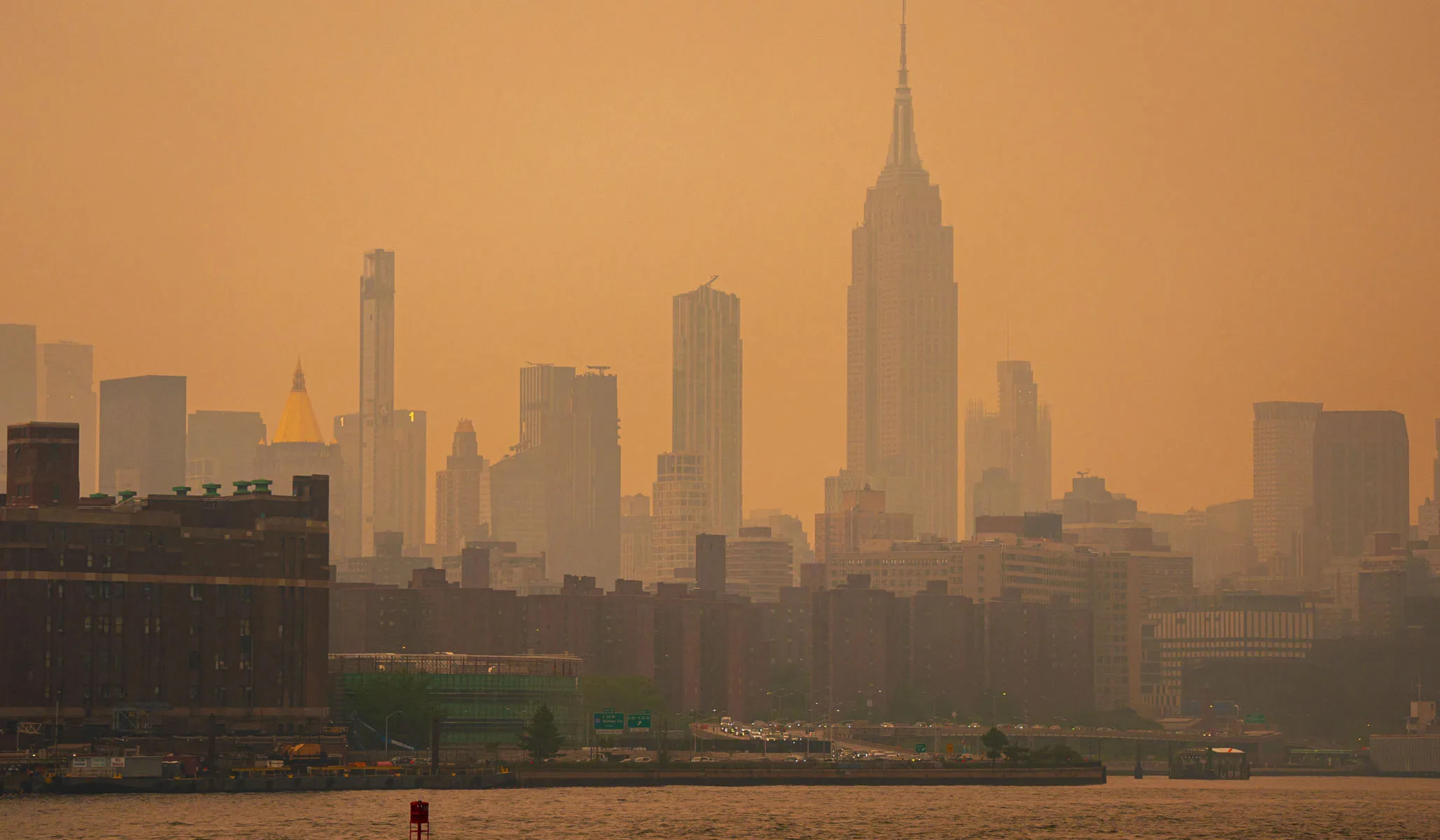
As Canadian wildfires burned out of control last week, much of the U.S. was covered in a noxious blanket of smoke, giving the air an orange tinge and keeping health-conscious Americans inside to wait out the air-quality alerts popping up on their iPhones.
Read more Thousands of Non-Citizens Added to New Jersey Voter Rolls Due to Technical Error
President Trump placed the blame squarely on Canada for failing to address what has become a regular wildfire problem north of the border. Just as in 2023 and 2025, the U.S., Trump said, was being “invaded” by smoke.
“[The] cost of this pollution must of necessity be added to the TARIFFS Canada is currently paying,” he said.
Trump was joined by Republican lawmakers from across the Midwest in blaming our neighbors to the north.
Representative Lisa McClain of Michigan blamed Canada’s “negligence” for the dangerous air blanketing much of the U.S., accusing Canada of doing “nothing” as wildfire smoke has crossed the border into the U.S. “year after year.”
As of Monday, more than 843 active wildfires were burning across Canada, with 181 of the fires labeled “out of control,” which means they are spreading and not responding to suppressive actions, while another 532 fires were similarly labeled as “out of control,” but had not yet been targeted by suppressive actions. In Minnesota, the Air Quality Index rose to 1,421, five times the safe limit.
Canadian Prime Minister Mark Carney has brushed off Trump’s criticisms, instead pointing to climate change as the leading cause of Canada’s fires.
“Fighting climate change is the responsibility of all countries, including the United States,” the Liberal Party leader told reporters last week.
Asked to adjudicate this blame game, experts in fire management and climatology told National Review the issue, as is so often the case when it comes to natural phenomena, is multicausal.
Andrew Vander Yacht, a professor of applied forest and fire ecology at the SUNY College of Environmental Science and Forestry in Syracuse, N.Y., explained that while climate change and forest management are the top determining factors when analyzing the cause of North American wildfires broadly, the primary factor to consider with these particular wildfires in Canada is their sheer remoteness.
More than 100 fires are burning in extremely hard-to-reach spots in the Boreal Shield Ecozone of Canada. The ecozone spans six provinces from northern Saskatchewan to Newfoundland, covering a landscape that is seven times the size of all of the U.S. national parks combined.
Suggesting that Canada had failed to adequately manage the area is “discounting the issues with managing such a broad landscape, it’s discounting how remote that landscape is,” Vander Yacht told NR. “These fires are occurring in areas where it takes six hours for a helicopter to get in with firefighters.”
Vander Yacht pointed to the “fire suppression paradox,” where the more governments work to put out forest fires, future fires come back bigger and more severe.
The fire suppression paradox tends to be less of a factor in the rural parts of the country that are currently burning, but Vander Yacht said some of the current fires would still be marked by that influence. “So I think it’s not prudent to discount the management side of this fully,” he said.
Canada shifted its approach to wildfires in the 1970s and 1980s, transitioning away from suppressing every fire in favor of policies that let fires burn, as long as they are not a threat to structural or societal resources. Today, Canadian officials can label fires “BOB” fires, or “Being Observed” fires, that are naturally occurring, lightning-caused wildfires that officials opt to monitor rather than actively suppress — though each province takes a different approach to fire management.
Read more Supreme Court to Hear Case of Alaskan Bush Pilot Who Had Plane Seized over Six Pack of Beer
“They are recognizing the important role that fire plays in managing fuels and the health of the ecosystem,” Vander Yacht explained. Allowing fires to burn creates a patchwork mosaic within forests of recently burned sites that would be less conducive to future fires, slotted between areas of more mature forest that are still susceptible to severe blazes. The boreal forests are known for black spruce trees that are highly flammable and “born to burn,” thanks in part to cones that only release seeds after a fire.
Environmental scientists have found black spruce trees razed by fire are replaced by leafy deciduous species, such as aspens, that are less flammable. But decades on, the Canadian forests are still within a period of ongoing adaptation, having not yet settled into an equilibrium, thanks to differing approaches to fire management throughout varying time periods and provinces.
“If we take that timeline, we’ve entered a time where we’ve got this kind of complicated disentanglement that we have to do with climate change and the human dimension of those decisions to manage wildfires, to allow them to burn to create those benefits that are attached to that,” Vander Yacht said.
Michael Flannigan, an expert on fire management at Thompson Rivers University in British Columbia, told the New York Times, “To be blunt, even if we spend a lot more money, I don’t think we could stop these fires.”
Jed Kaplan, a professor in the Department of Earth, Energy, and Environment at the University of Calgary, told the Atlantic: “You can’t control these fires. You cannot put personnel, fire engines, over an area that is the size of the entire American South, or something like that. It’s just way too big of an area.”
Climatologist Zeke Hausfather explains on his Substack that the fires are burning “across enormous remote areas that have never been logged, thinned or effectively suppressed.”
“You cannot have a fuel-buildup from forest mismanagement in a forest you were never managing,” he writes.
That was less the case back in 2023, the last time many Americans will remember living through hazy skies and dangerous air quality thanks to Canadian wildfires. Those fires, however, burned in different parts of Canada than the current fires. Those areas, in Quebec and eastern Ontario, were less remote, more accessible to firefighting crews, and subject to more forest management, and thus, mismanagement. Poor forest management can build up a “fire deficit” that raises the odds of severe fire. In those cases, mechanical thinning and prescribed burning “measurably reduces subsequent fire severity,” Hausfather writes.
In 2023, Vander Yacht suggested that humans had gone too far in trying to stop fires that are a natural part of the forest life cycle.
“This has really led to an accumulation of fuels and fuel loads that are out of whack with what we historically would have seen,” he said.
But in the boreal region, researchers with the Canadian and U.S. Forest Services found in 2020 that mechanical fuel treatments “require continued maintenance over time, are too expensive to apply across large boreal landscapes, and are usually not designed to halt extreme wildfires.”
Canada’s Minister of Emergency Management Eleanor Olszewski, like other Canadian officials, has defended the country’s forestry practices.
“Warmer, drier weather is becoming more common, increasing wildfire risk in Canada and around the world,” Olszewski said in a statement. “Northern Ontario and Quebec, for example, received less than 40 percent of normal precipitation this June, with temperatures above historical averages.”
However, wildfire activity in 2026 is below Canada’s five-year average and the affected area is within the natural range for the last 200 years.
Read more Anti-ICE Extremist Sets Fire to NYC Federal Building